- Lucie TESTARD
- - June 8, 2026
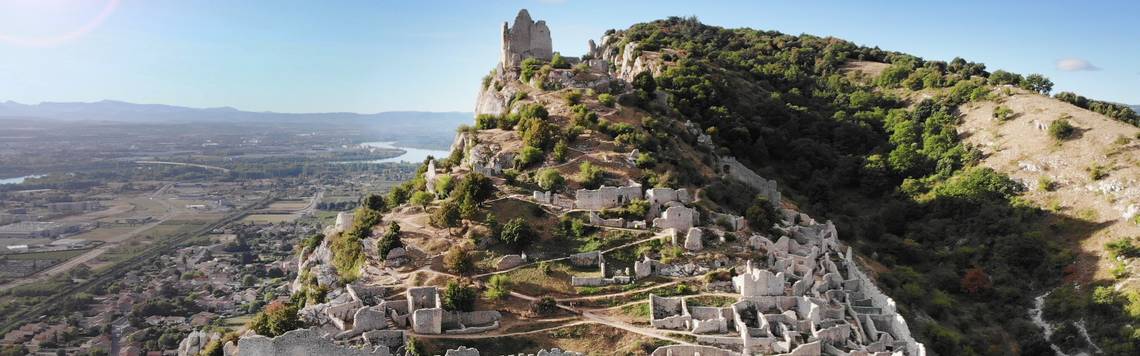
Towering majestically over the Rhône Valley from its rocky outcrop, Crussol Castle is one of the most remarkable medieval sites in the Ardèche. Situated on the heights of Saint-Péray, opposite Valence, it bears witness to several centuries of history and the strategic importance of this region in the Middle Ages.
The origins of the castle
The earliest records of Crussol date back to the late 10th century. Around 936, a document from the cartulary of Saint-Chaffre Abbey in Le Monastier mentions a "castellum de Cruciolo", evidence of the existence of an early fortification.
At that time, it was probably just a wooden castle with a palisade, without any major stone structures. Little is known about the first occupants, and the site only truly entered the historical record with the emergence of the Crussol family in the 12th century.
In 1110, Géraud Bastet, following his marriage to Agnès, heiress of the House of Crussol, undertook the construction and fortification of the castle. This stage marked the true development of the medieval fortress.
Over time, particularly from the 12th century onwards, the fortifications gradually evolved into a more structured stone complex, marking the transition from a simple defensive outpost to a fully organised seigneury.
An exceptional strategic location
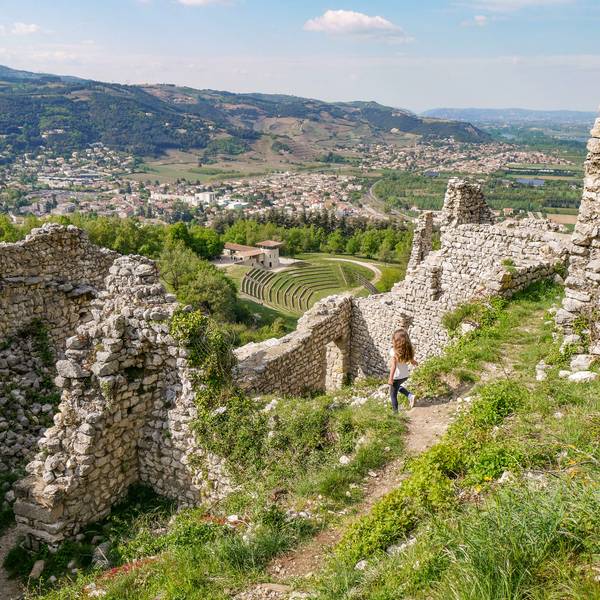
Crussol Castle owes its strategic importance to its commanding position, perched some 200 to 400 metres above the valley, depending on the terrain. From its rocky outcrop, it commands a sweeping view of the Rhône Valley, the surrounding vineyards and the Vercors hills.
In the Middle Ages, the Rhône was a vital trade and military route linking the Mediterranean with Northern Europe. This waterway was used by merchants, travellers and armies.
From Crussol, the lords could observe movements in the valley, monitor the crossings and potentially collect taxes or control trade. This role as a territorial stronghold explains the site’s strategic importance across the entire region.
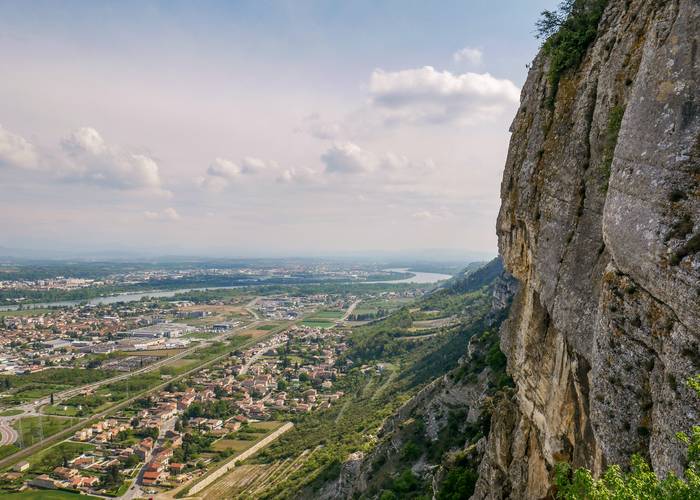
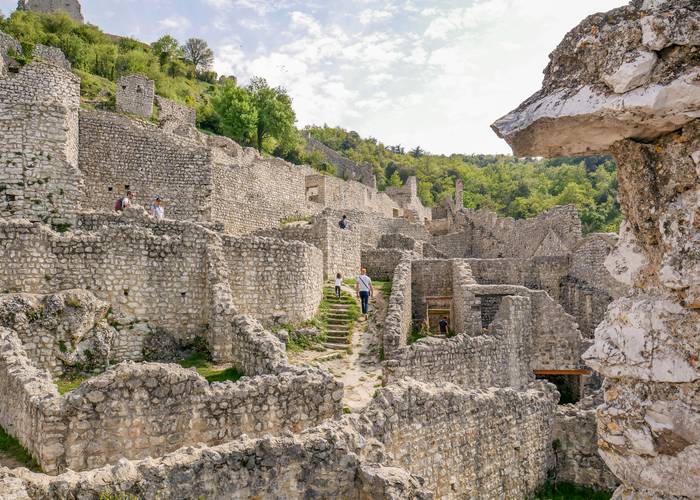
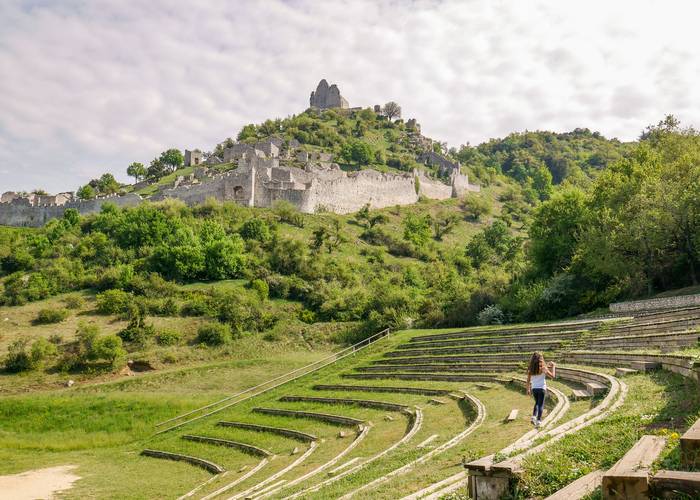
«Overlooking the town of Valence, on a mighty rocky promontory, stand the imposing ruins of Crussol Castle and its fortified settlement. The site occupies the northern tip of a long limestone ridge overlooking the Rhône Valley, in an area that has been densely populated since Late Antiquity and the Early Middle Ages.» (P.-Y. Laffont, 2004)
A thriving medieval town
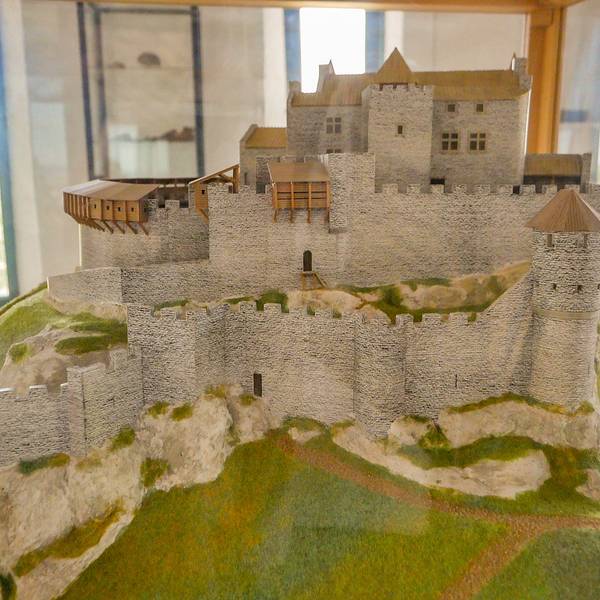
At its height, between the 12th and 14th centuries, Crussol was more than just a castle: it was a fully-fledged fortified town covering almost three hectares.
The site comprises the main castle and a castle town known as "La Villette". It is estimated that around 600 inhabitants lived within the ramparts, and up to 900 if the agricultural areas at the foot of the fortress are included.
The population consisted of craftsmen, soldiers, merchants, clergy and peasants. Archaeological excavations have revealed the presence of forges, evidence of a dynamic economy. The site was organised into specialised quarters, with storage areas, cisterns and systems designed to withstand sieges.
This organisation made Crussol a truly self-sufficient community, a rarity for a hilltop fortress.
The Rise of the Crussol Family
From the 12th century onwards, the Crussol family gradually established itself as the lords of the site. In 1152, several members of the family (including Gérard Bastet, Guillaume and Aldebert de Crussol) held the castrum in joint ownership, a sign of shared family management.
In 1217, the lords of Crussol strengthened their regional influence following a conflict between the Bishop of Valence and Lord Gontrand de Chabeuil. As the latter refused to settle a debt owed to the Bishop of Miribel, the lords of Crussol and Tournon intervened and took part in the destruction of Chabeuil Castle. In reward for this service, the lords of Crussol were granted the castle of Charmes-sur-Rhône.
The family subsequently strengthened its influence through alliances and services rendered to the kingdom’s powerful figures. In 1355, the lord of Crussol paid homage to the Bishop of Valence, and the castle was described as a ‘noble and ancient fief’.
The 15th century marked the height of this rise. Louis de Crussol became close to the future Louis XI whilst he governed the Dauphiné.
On 24 June 1486, Jacques I of Crussol married Simone d’Uzès, the last heiress to the viscounty of Uzès. This union greatly increased the family’s power and gave rise to the House of Crussol-Uzès. Against a backdrop of relative peace, both the lords and the inhabitants gradually left the Crussol massif to settle on the plain, which was more conducive to economic development and a more comfortable way of life.
The Wars of Religion and the decline of the castle
From the 16th century onwards, the castle gradually ceased to serve as a residence. The lords of Crussol preferred to take up residence in homes more befitting their rank.
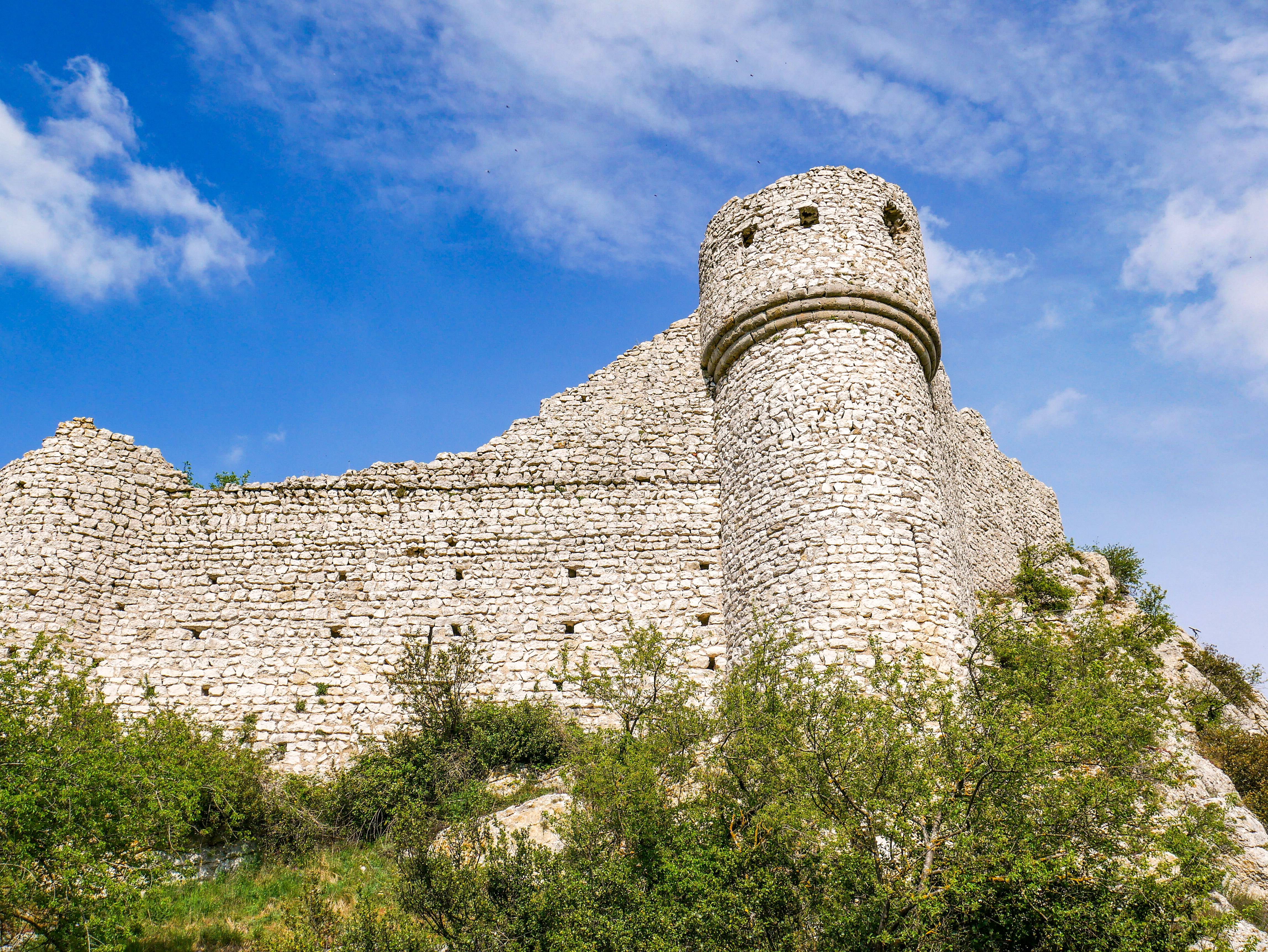
The site nevertheless remained a key military stronghold during the Wars of Religion. Between 1573 and 1578, Crussol was captured on five occasions. The castle was set on fire, its defences destroyed and the keep razed to the ground.
By 1649, the parish chronicle of Saint-Péray was already describing Crussol as a "ruin", that is to say, a dilapidated and uninhabitable place. The Wars of Religion and the five assaults suffered between 1574 and 1622 had thus finally brought its ramparts and keep to an end.
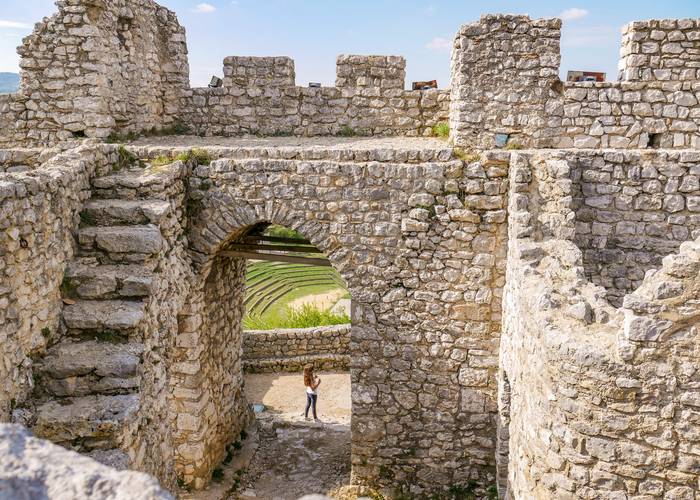
Later, in the 19th century, quarrying further worsened the condition of the ruins. On 3 October 1855, a large explosive charge used in a quarry south of the castle caused the collapse of around a quarter of the stately residence, part of which was visible from the Valentinoise plain. Numerous blocks of masonry were hurled and scattered across the site, and can still be seen today.
Ruins steeped in history
Today, Crussol Castle is a major heritage site, protected and promoted.
On 31 May 1927, the site was listed in the supplementary register of Historic Monuments, a crucial step in its preservation. In 2027, this listing will celebrate its centenary !!
A new phase of conservation began in 1984 when the town of Guilherand-Granges acquired the castle ruins and the surrounding land. In 1988, an inter-municipal association comprising Guilherand-Granges, Saint-Péray and Soyons was established to launch the first major restoration works, including in particular the clearing of scrub and the cleaning of the site.
Work to enhance the site continued in the early 2000s with the construction of the visitor centre and its panoramic tower in 2000, on the site of a former 19th-century farm. In 2002, an open-air theatre was built to host performances, cultural events and historical re-enactments.
Finally, in 2009, the Crussol massif received dual environmental recognition by being designated a Sensitive Natural Area (ENS) and included in the Natura 2000 network. This protection highlights the site’s ecological richness, which is home to some forty species of wild orchids.
The giant Crussolius
Beyond its documented history, Crussol Castle is also shrouded in numerous legends. The most famous is that of Crussolius, a giant who is said to have built the first fortress on the rock overlooking the Rhône.
According to tradition, the lords of Crussol traced their origins back to this legendary figure, described as a king of the Arverni. Standing nearly seven metres tall, Crussolius is said to have built the castle and given his name to the site. Faced with the vastness of the fortress and its spectacular location, the locals found it hard to imagine that a mere man could have been behind such a structure.
In the 19th century, some even claimed that a giant’s skeleton had been discovered amongst the castle ruins. Although no evidence has ever confirmed this story, it has gone a long way towards fuelling the mystery of the place, and this is still the case today.
👉 To find out more about the various legends and folk tales surrounding the Ardèche, a dedicated article is available : The 5 must-know myths and legends of the Ardèche

Why not visit Crussol?
Crussol Castle is open to the public all year round, with no admission fee. The visitor centre and activities are mainly available in spring and summer.
Visitor centre opening hours:
- April : Tuesday to Sunday, 1.30 pm to 6.30 pm
- May and June : Tuesday to Sunday from 10.00 am to 1.00 pm and from 3.00 pm to 6.30 pm
- July and August : every day from 10.00 am to 1.00 pm and from 2.30 pm to 7.00 pm
- September : Tuesday to Sunday from 1.30 pm to 6.30 pm
- October and the autumn half-term holidays : Saturdays and Sundays from 1.30 pm to 5.30 pm
On site, you can enjoy guided tours, workshops, walks, exhibitions and cultural events such as concerts. The site also has picnic areas and information points where you can learn about its history and surroundings.
For further information, please contact the Maison des Vins et du Tourisme on 04 75 40 46 75 or visit the Crussol Castle website
Photographers: ©Cyril Arnaud (cover photo) and ©Gaelle Bailleul