- Lucie TESTARD
- - Aug. 11, 2026

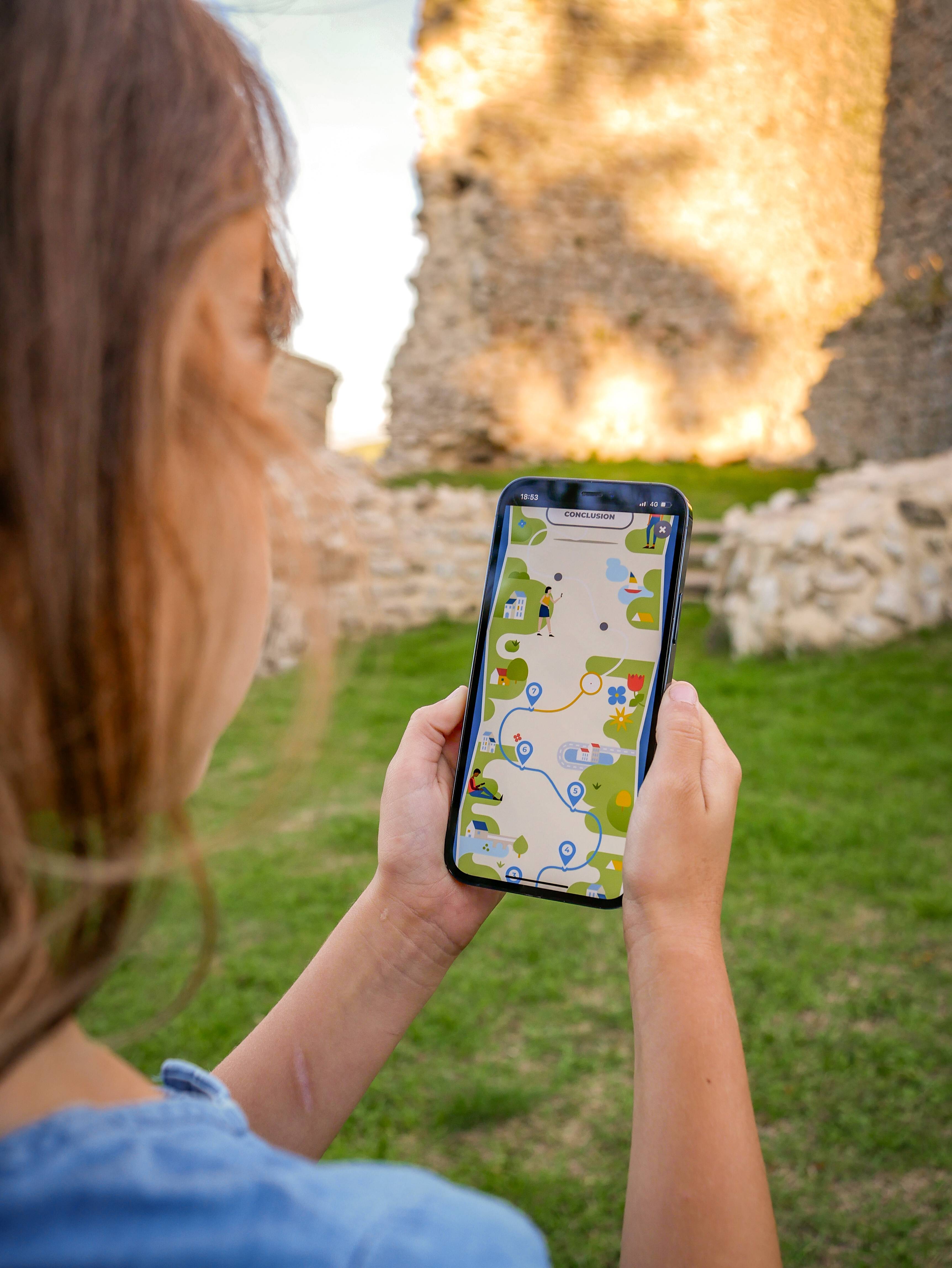
Fancy (re)discovering the Rhône Crussol region in a different way ? We’ve come up with a new way for you to explore this little corner of the Ardèche: each of the region’s 13 municipalities has its own digital Baludik trail (in French and English), a free app featuring treasure hunts and fun walks. Through 13 adventures, 13 stories and 13 different worlds, set off to discover a unique region !
What exactly is Baludik ?
Baludik is a mobile app (available on iOS and Android, free of charge) that turns a simple stroll into a location-based treasure hunt : puzzles, clues, local facts and little stories punctuate the route.
The idea is simple :
- Download the Baludik app.
- Select a route within the app (or scan the QR code for your chosen route).
- Let the geolocation guide you, solve the puzzles, and follow the story until you reach the finish.
The trails can even be downloaded in advance and played offline once you’re there !
In the area, each trail is linked to one of these three main themes :
History : to follow in the footsteps of the village’s past
Heritage : to discover monuments, narrow streets and landscapes
Entertainment : for a more playful adventure, often designed for families
The 13 courses at a glance
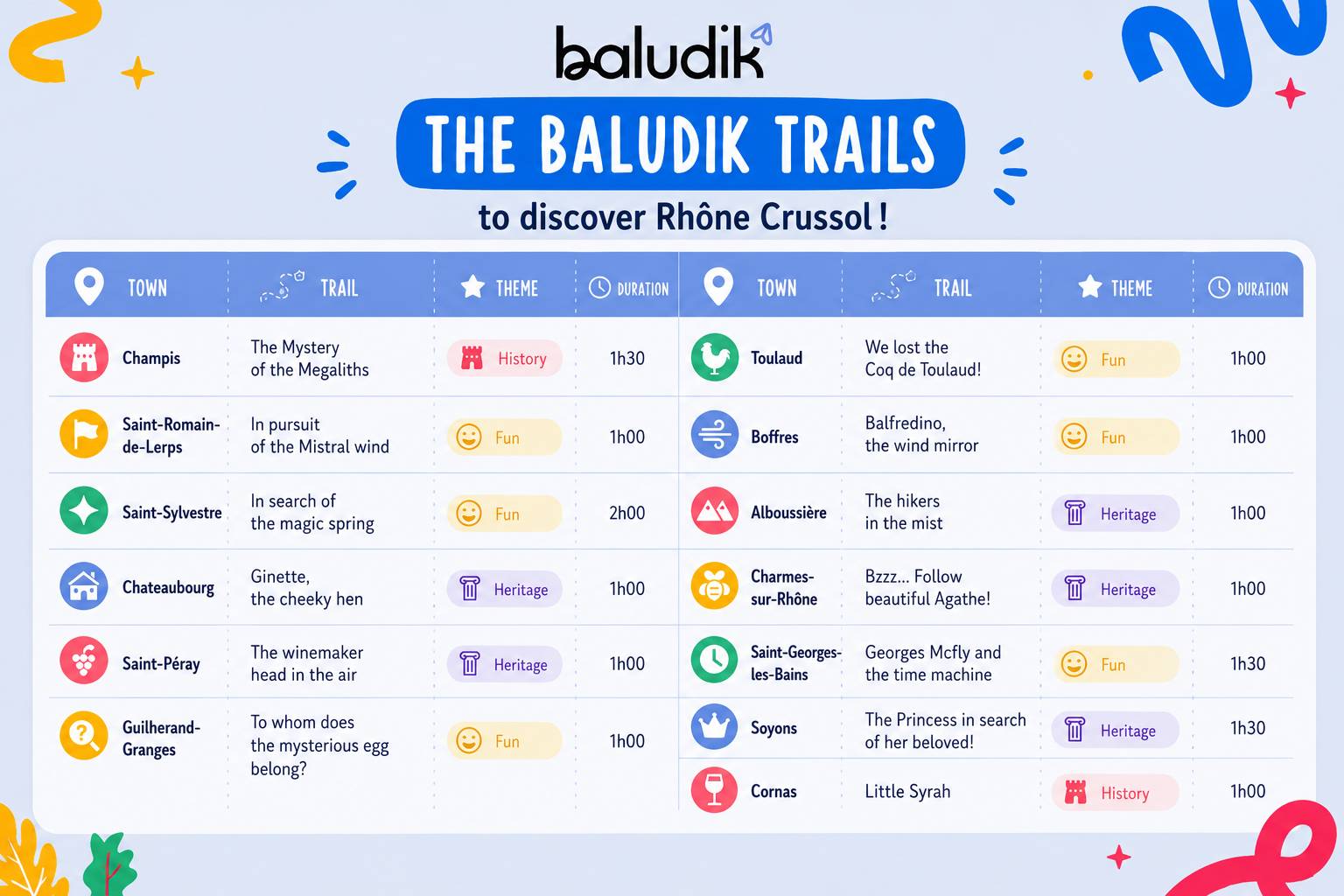
Details of the 13 routes
1. Champis : The Mystery of the Megaliths
Perched on the plateau, the village of Champis (comprising 72 hamlets!) is home to one of the region’s few megalithic sites. The game invites you to investigate the origin of these mysterious rocks scattered across the countryside: prehistoric heritage, the legend of Tom Thumb, or a more rational explanation – it’s up to the players to decide.
Starting point : La Bâtie de Crussol, car park opposite the town hall
What you’ll see : the path winds its way through meadows and copses, taking you past around thirty megaliths scattered across the landscape, including the famous "wobbly stone", a boulder weighing around 70 to 80 tonnes that vibrates when pressed with a hand. It is one of the few megalithic sites in the entire Rhône Crussol area, set against a backdrop of rolling hills and chestnut groves typical of the Vivarais plateau.
Good to know : signposted route; not suitable for pushchairs or wheelchairs (steep paths); bring a picnic
2. Saint-Romain-de-Lerps : In pursuit of the foal Mistral
A foal has escaped from the Bressieux Stables and Cléa needs help to find him! A family adventure that winds its way through the village, renowned for its panoramic views of the Alps.
Starting point : Les Tilleuls car park, Route de Saint-Sylvestre
What you’ll see : the highlight of the route is the famous 360° panoramic view from Le Pic, at an altitude of 650 metres, with its two orientation tables situated either side of a small Romanesque chapel. On a clear day, the view stretches across no fewer than 13 departments, as far as the Vercors, the Alps and even Mont Blanc. The village itself, nestled on the ‘Balcons du Rhône’, also winds its way through cherry and apricot orchards.
Good to know : one-way route, accessible to pushchairs and (with assistance) to people with reduced mobility
3. Saint-Sylvestre : In search of the magical spring
The longest of the 13 walks (2 hours). Gabin, the village cat, has lost track of a legendary spring once frequented by the local lords. Head off along the narrow paths, a picnic basket and a baguette are recommended for early-morning explorers.
Starting point : Gournier Bridge car park, Bogari
What you’ll see : the famous ‘magical spring’ featured in the game corresponds to the Romanesque chapel of Saint-Martin-de-Galéjas and its fountain, renowned for centuries for curing skin ailments (hence its nickname "Galéjas"). The route also runs alongside the River Duzon and an old bridge, through the peaceful, leafy valley that has earned the village its nickname as a "rural getaway".
Good to know : one-way route; narrow paths not accessible to pushchairs or wheelchairs
4. Châteaubourg : Ginette, the coquettish genet
Ginette the genet leads young and old alike from the bottom to the top of the village, through narrow streets steeped in history and mystery.
Starting point : car park at the northern entrance to the village
What you’ll see : as you make your way down through the village, your gaze is drawn to Roche Faucon Castle (also known as Châteaubourg Castle), which has stood perched on its rocky outcrop since the 11th century, directly overlooking the River Rhône. Narrow alleyways, staircases and views of the river punctuate the walk through this village, which for many years formed the border between the Kingdom of France and the Holy Roman Empire.
Good to know : accessible to pushchairs and, depending on the route taken, to people with reduced mobility (a few sloping sections)
5. Saint-Péray : The absent-minded winegrower
In the local capital of sparkling wine, a winegrower has lost his memory after falling on his head. He really needs a helping hand to rediscover his own town!
Starting point : near the Maison des Vins et du Tourisme
What you’ll see : the route takes you through the town renowned for its sparkling wine, dominated by the Château de Beauregard, which watches over it. Saint-Péray is also the easiest way to reach the ruins of the Château de Crussol, an iconic rocky outcrop visible from much of the village.
Good to know : the route is accessible to pushchairs and wheelchairs, and is one of the most accessible in the selection
6. Guilherand-Granges : Who owns the mysterious egg ?
A puzzling green egg has been found at the kiosk on the banks of the Rhône. It’s up to you to help Augustin unravel the mystery as you walk along the riverbanks.
Starting point : kiosk on the banks of the Rhône
What you’ll see : a stroll along the banks of the Rhône, following the route of the Voie Bleue, with views of the Crussol massif overlooking the town (Crussol Castle is, incidentally, officially owned by Guilherand-Granges, although it is situated in Saint-Péray).
Good to know : one-way route, pushchair-friendly (just one flight of stairs along the way)
7. Toulaud : The Toulaud Rooster has gone missing!
The rooster voted "the village’s finest" has vanished just before the Coq Vierge festival. Téo, who was in charge of looking after him, is counting on you to find him and, whilst you’re at it, to learn more about the village’s legends and secret passages.
Starting point : the Mulberry Trees car park, behind the hairdresser’s
What you’ll see : perched on its rocky outcrop, Toulaud reveals its narrow alleyways and cobbled streets typical of an old fortified market town, with the Catholic church and the Protestant church facing each other on either side of the village and an unobstructed view of the Vercors. A cheeky nod: every 14 July since 1970, Toulaud has celebrated a genuine "Fête du Coq Vierge" (Festival of the Virgin Rooster), which directly inspired the game’s storyline !
Good to know : one-way route; not suitable for pushchairs or wheelchairs
8. Boffres : Balfredino, the mischievous breeze
The village’s name is said to derive from ‘Balfredo’, a rock swept by an icy wind. From this wind is said to have emerged Balfredino, a mischievous spirit who enjoys stealing sounds and objects – in this case, a piece of music that has blown away, which you must find by walking through the village from the bottom to the top.
Starting point : free car park behind the town hall, Rue de la Gare
What you’ll see : as you climb the village’s cobbled streets, you’ll come across the remains of the 12th-century medieval castrum, including a circular keep made of pink granite. The church square at the top offers a panoramic view stretching as far as the Alps and the Massif Central on a clear day.
Good to know : the route features steps and is difficult for pushchairs and wheelchairs
9. Alboussière : Campers on the go
An empty cool box one summer morning at La Duzonne campsite, by the lake: here are the campers, in survival mode, setting off on a gourmet stroll in search of great local spots.
Starting point : entrance to La Duzonne campsite
What you’ll see : the walk takes you around the pretty lake fed by the River Duzon, set amongst the green hills typical of the Ardèche Verte. Nearby (off the route), the remarkable garden at La Terre Pimprenelle and its collection of Ginkgo biloba trees are also well worth a visit.
Good to know : a route accessible to all, with a family-friendly and convivial atmosphere
10. Charmes-sur-Rhône : Bzzz… Follow the lovely Agathe!
A young bee called Agathe guides visitors through the narrow streets of this village, rich in both heritage and natural beauty, taking them past remarkable sights and charming spots to wander around.
Starting point : Place Lorraine, town hall car park
What you’ll see : built directly into the rock above the Rhône, the village reveals its cobbled streets and medieval stone-paved stairways, the ruins of its former feudal castle, and, beneath the steps of the town hall, the astonishing Gallo-Roman sarcophagus of Alethius. All against the backdrop of the river glistening below.
Good to know : there are a few road crossings to watch out for; make sure your GPS is switched on
11. Saint-Georges-les-Bains : George McFly and the time machine
A deliberate nod to "Back to the Future": George McFly has found a time machine in the town hall square and is desperately searching for his winning lottery ticket, which he has lost somewhere in the village.
Starting point : Town Hall Square
What you’ll see : the village’s name says it all, an alkaline-sulphurous thermal spring with a constant temperature (24–25°C) has been flowing here since ancient times, making the village one of the first in France to have a swimming pool, which was frequented by the young Napoleon Bonaparte in 1785. The route also takes you past the village’s old fountain and through its hillside alleyways, with views over the valley.
Good to know : this route is designed for a leisurely stroll; take care when crossing roads
12. Soyons : The Princess in Search of Her Beloved !
A princess wanders the narrow streets of Soyons in search of her missing lover – the perfect excuse for a stroll through the village’s rich heritage. A bit of physical exertion is to be expected towards the end of the route.
Starting point : Chemin de la Tour car park
What you’ll see : the car park’s name gives a clue – the route leads to the Leaning Tower, the sole remnant of Soyons’ medieval castle, perched on the cliff overlooking the Rhône. The village is also famous for its exceptional prehistoric heritage: the Néron Caves and the Trou du Renard, inhabited as far back as the time of Neanderthals, are accessible right nearby (outside the Baludik route).
Good to know : one-way route; bring water; the final stretch of the walk is a bit more challenging
13. Cornas : Little Syrah
It’s impossible to talk about Cornas without mentioning the wine: Syrah, the winemaker’s granddaughter, leads players through the narrow streets of this village, whose history is inextricably linked to its vineyards.
Starting point : the Salle des Fêtes car park
What you’ll see : the narrow streets of this wine-growing village, nestled around its Saint-Pierre church with its slender bell tower, wind their way between stone houses and rows of vines that produce the Cornas AOC, a red wine said to have been appreciated since the time of Charlemagne. To the north of the village, the Notre-Dame-de-la-Mûre chapel and its 13th-century Black Madonna complete the picture.
Good to know : there are a few steps along the route; the route is not accessible to pushchairs or wheelchairs
How to prepare properly for your Baludik outing ?
Make sure your smartphone is fully charged : almost all routes remind you of this – it’s THE essential step.
Location services enabled : the app needs this to guide you in real time.
Check the direction of the route : several games (Saint-Romain-de-Lerps, Saint-Sylvestre, Guilherand-Granges, Toulaud, Soyons) are one-way routes, not loops, so do think about how you’ll get back.
Accessibility varies considerably : Saint-Péray, Alboussière and Saint-Romain-de-Lerps are well suited to pushchairs and people with reduced mobility, whilst Champis, Toulaud, Boffres and Cornas include steeper sections (stairs, footpaths).
Allow plenty of time : the stated duration (1 to 2 hours) is a guide only; most routes explicitly encourage you to take your time along the way.
Download the app :